Examples of the exploration of plants materiality in the writings of Jean-Baptiste Labat (XVIIth – XVIIIth Century)
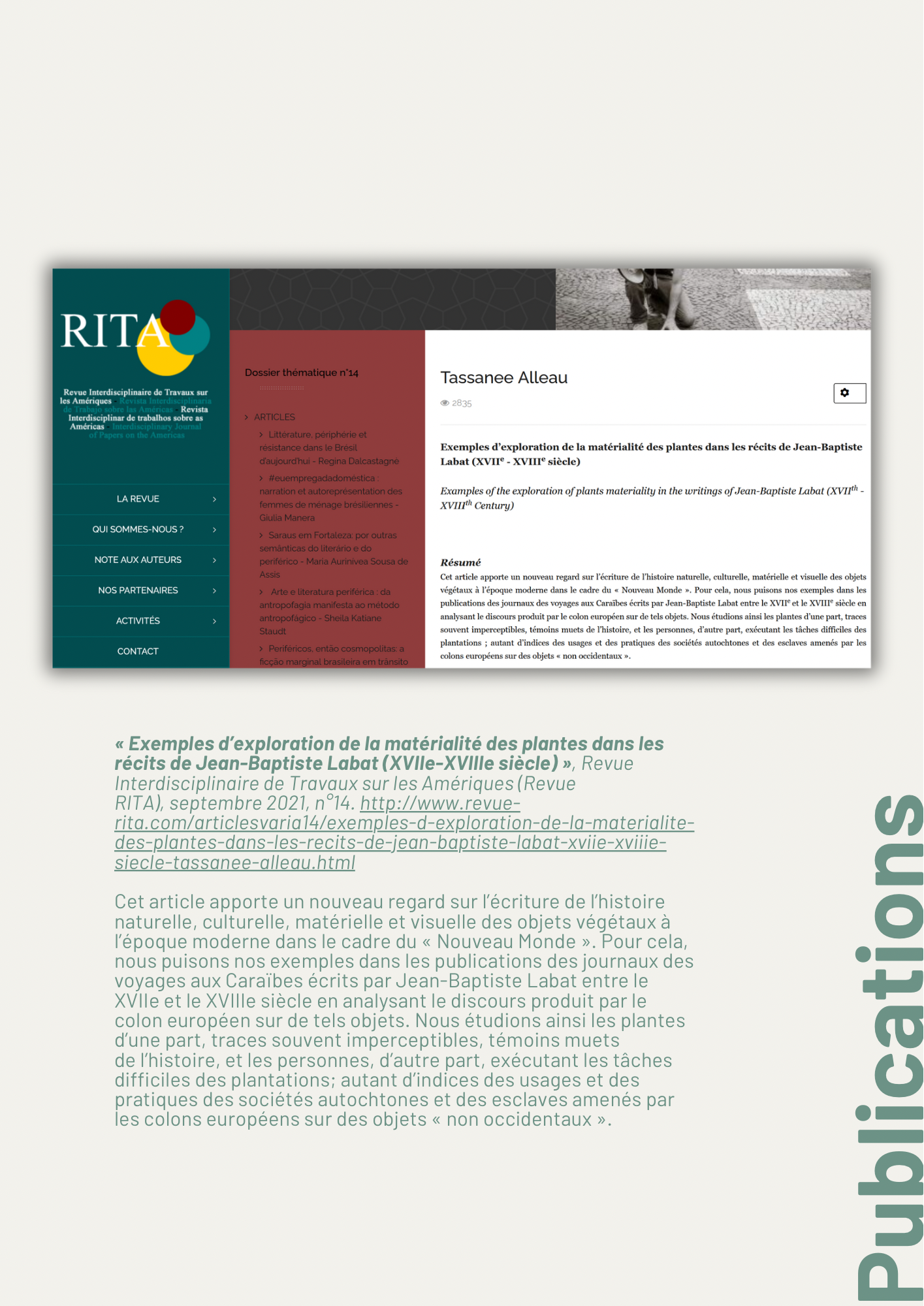
« Exemples d’exploration de la matérialité des plantes dans les récits de Jean-Baptiste Labat (XVIIe-XVIIIe siècle) », Revue Interdisciplinaire de Travaux sur les Amériques (Revue RITA), septembre 2021, n°14. http://www.revue-rita.com/articlesvaria14/exemples-d-exploration-de-la-materialite-des-plantes-dans-les-recits-de-jean-baptiste-labat-xviie-xviiie-siecle-tassanee-alleau.html
Cet article apporte un nouveau regard sur l’écriture de l’histoire naturelle, culturelle, matérielle et visuelle des objets végétaux à l’époque moderne dans le cadre du « Nouveau Monde ». Pour cela, nous puisons nos exemples dans les publications des journaux des voyages aux Caraïbes écrits par Jean-Baptiste Labat entre le XVIIe et le XVIIIe siècle en analysant le discours produit par le colon européen sur de tels objets. Nous étudions ainsi les plantes d’une part, traces souvent imperceptibles, témoins muets de l’histoire, et les personnes, d’autre part, exécutant les tâches difficiles des plantations; autant d’indices des usages et des pratiques des sociétés autochtones et des esclaves amenés par les colons européens sur des objets « non occidentaux ».
English : Summary
This article offers a new methodological approach to the writing of natural, cultural, material, and visual histories of plants in early-modern period. For this, we draw on examples from the published journals of Jean-Baptiste Labat regarding his exploration of Caribbean islands and territories in the seventeenth century and eighteenth centuries. On the one hand, our goal is to study plants as objects and their invisible traces as silent witnesses of history. On the other hand, we examine the harsh working conditions on plantations, and the practices of colonists, indigenous Americans and slaves dealing with plants as materials of knowledge in the form of drugs / remedies, food, artisanal and ethnographic objects. This “work-in-progress” research and methodological approach aim at looking anew at the sources, decentering our perception, considering the materiality of these “non-Western” objects, and analyzing the discourse produced by the European colonists concerning such objects.
Laisser un commentaire